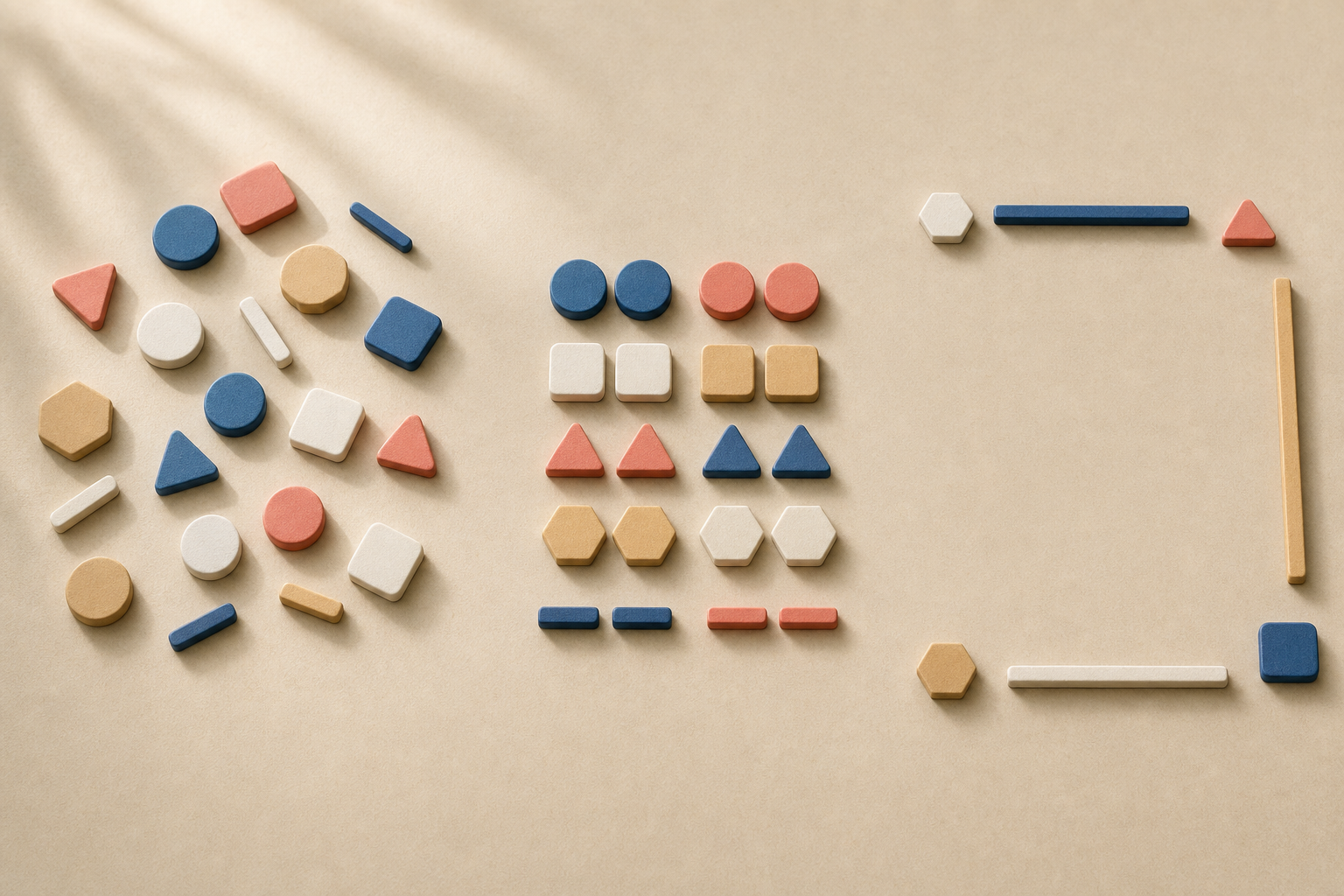
A merge board fills too quickly when every open tile is treated as available. Instead, assign each tile a job before producing more pieces: keep low-level generators in one zone, give one useful merge chain a separate working zone, and protect a small reserve for the current order. Read the order first, expand only the chain that serves it, and pause any action that would consume the reserve without creating an immediate match or advancing that order.
This is not one supposedly perfect layout. It is a way to make the cost of each new piece visible. The board can change, but its jobs remain distinct.
The three-zone space budget
Use a blank sketch of your current board rather than copying a fixed grid. Mark unavailable positions as blocked, then divide the usable positions by function:
- G — Generator zone: the area for low-level generators and the pieces that first appear around them.
- A — Active-chain zone: the only area where the chain you are deliberately building may spread.
- R — Order reserve: open positions protected for matching pieces needed by the current order.
The reserve is a budget, not spare space. If an action needs a reserve position but does not help form a match or move the chosen order forward, treat that action as unaffordable for now.
CURRENT ORDER: __________________________________________
ACTIVE CHAIN THAT SERVES IT: _____________________________

BOARD SKETCH                         SPACE CHECK
┌──────────┬──────────┬──────────┐   Generator zone: ___ occupied / ___ available
│    G     │    A     │    R     │   Active zone:    ___ occupied / ___ available
│generator │  active  │ reserve  │   Order reserve:  ___ open positions protected
├──────────┼──────────┼──────────┤
│ Mark actual unavailable positions here: ______________ │
└──────────┴──────────┴──────────┘

NEXT USEFUL MATCH: _______________________________________
PIECES OUTSIDE THEIR ZONE: _______________________________
ACTION TO PAUSE: _________________________________________
RECHECK TRIGGER: match made / order changes / zone is full
The labels describe functions, not permanent geography. A corner, row or cluster can serve as a zone if its boundary is easy to remember. When the current order changes, redraw the active-chain boundary rather than letting yesterday's chain keep occupying today's working area.
The ORDER gate: decide before adding a piece
Apply the ORDER gate before an action that can add another piece:
- O — Observe the current order. Name the one order you are pursuing now. If you cannot say which order an action serves, it has no claim on active space.
- R — Reserve working room. Identify the open positions that must remain available for matching and order-related pieces. Do this before treating an empty position as free.
- D — Direct one chain. Choose the merge chain most relevant to the order. Keep its pieces together in the active zone; do not open a second speculative chain merely because a position is empty.
- E — Execute immediate matches first. Scan for equal pieces already present. In MakoBits, equal objects combine into the next evolution, so resolving an available match reduces fragmentation and keeps the chain legible.
- R — Recheck the budget. After a match, an order change or a full zone, count the roles again. Move boundaries if needed; do not silently spend the reserve.
This gate separates two questions that crowded boards often blur: “Can I take this action?” and “Can my board afford the piece it may create?” The second question should decide.
Example: resetting a crowded MakoBits board
Suppose a player has low-level generators along one side, pieces from two developing chains scattered through the centre, and only a few uncommitted positions. The current order points to Chain Blue. Chain Amber does not serve that order. The markers below are abstract; they do not represent any unverified MakoBits item, board size or drop behaviour.
G = low-level generator   b/B = Blue-chain pieces
                         a/A = Amber-chain pieces
. = open position

Before (abstract arrangement only)
┌───┬───┬───┬───┐
│ G │ b │ a │ . │
├───┼───┼───┼───┤
│ G │ A │ b │ . │
├───┼───┼───┼───┤
│ a │ B │ . │ . │
└───┴───┴───┴───┘
First, the player writes “Chain Blue” in the active-chain field. That removes a false choice: Chain Amber will not be expanded during this cycle. Next, they identify any equal Blue pieces that can be matched now and keep the resulting Blue progression in the active zone. They group the non-active Amber markers away from the Blue workspace without assuming that pieces can be deleted, stored or converted; none of those behaviours is established by the supplied information.
Finally, they label the remaining uncommitted positions as reserve rather than “empty”:
After zoning (not a promised board outcome)
┌───────────┬───────────┬───────────┐
│ G: low-   │ A: Blue   │ R: open   │
│ level     │ chain     │ for order │
│ generators│ together  │ work      │
└───────────┴───────────┴───────────┘
Paused: expansion of Chain Amber
Next recheck: after a Blue match or an order change
The useful change is not a claimed number of cleared positions. It is that every occupied or open position now has a declared purpose. When the player considers producing another piece, the ORDER gate gives a yes/no decision: it must fit the generator or active zone, support the current order, or create an immediate match. Otherwise, it waits.
Crowded-board decision table
Use this table from top to bottom. Stop at the first row that describes the situation.
| Situation | Decision | Reason |
|---|---|---|
| Equal pieces already form an available match | Make that match before expanding another chain | It advances an existing chain and reduces scattered duplicates |
| A piece directly supports the chosen order | Keep it in the active zone or protected reserve | The order gives the piece a defined purpose |
| The generator zone is spilling into the reserve | Pause the space-adding action and restore the boundary | Reserve positions are working capacity, not overflow |
| A second chain is growing but does not serve the chosen order | Stop expanding it for this cycle | Parallel chains compete for open positions |
| The active zone is full and no immediate match is available | Reconsider the active chain before adding anything | More pieces may increase congestion without resolving it |
| The order changes | Redraw the active and reserve zones | The chain that deserved space may no longer be the priority |
| You do not know what an action will add | Require room for uncertainty or postpone it | Unknown output should not be funded with protected space |
The final row is a planning rule, not a claim about random outputs in MakoBits. It applies whenever the player lacks enough information to predict the next board state.
Implementation steps for your next play session
1. Map the board you actually have
Sketch its usable shape. Mark positions that are currently unavailable, whatever the in-game reason may be. Do not borrow a layout or zone ratio from another player; this method intentionally avoids assumptions about dimensions.
2. Choose one order-led objective
Read the current orders before spending space. Select the chain that has the clearest relationship to the order you intend to pursue. Write that chain at the top of the worksheet.
3. Draw hard boundaries
Place low-level generators in G, the selected chain in A and protected working room in R. Boundaries can be mental, but a quick sketch prevents “temporary” pieces from quietly consuming the reserve.
4. Consolidate before expanding
Scan the board for equal pieces in the selected chain. In MakoBits, matching equal objects produces the next evolution. Resolve available matches before starting unrelated work, then gather the active chain back into its zone.
5. Apply an admission rule
Before adding a piece, require at least one answer to be yes:
- Will it support the selected order?
- Will it complete an immediate match?
- Does its designated zone have room without touching the reserve?
If all three answers are no, pause. An open tile alone is not permission.
6. Re-zone at defined moments
Recheck after a match, when an order changes, or when any zone reaches its boundary. These triggers prevent constant rearranging while still stopping an obsolete chain from holding space indefinitely.
7. Keep the next action explicit
Finish each check with one sentence: “My next useful match is ___.” If that blank cannot be completed, review the order, pieces and boundaries rather than expanding automatically.
For verified background on MakoBits' matching, order and collection loop, visit the MakoBits game overview.
A two-minute board-pressure checklist
- [ ] I have read the current order.
- [ ] I have selected one active chain that serves it.
- [ ] Low-level generators have a defined zone.
- [ ] Active-chain pieces are together rather than scattered.
- [ ] The order reserve is labelled and protected.
- [ ] I checked for available equal-piece matches.
- [ ] I am not expanding a second chain merely because a position is open.
- [ ] The next piece has a named destination before I add it.
- [ ] I know which event will trigger the next re-zone.
- [ ] I can state my next useful match in one sentence.
If any of the middle six checks fails, fix the layout or pause the proposed action before continuing.
Limitations
This framework is a space-management aid, not a universal optimal strategy. The available evidence does not establish MakoBits' board dimensions, storage or deletion behaviour, generator timing, drop rates, item values, or ideal zone sizes. Accordingly, the worksheet uses no fixed percentages and promises no particular outcome.
A strict single-chain focus also has a trade-off: it may delay another chain. That is intentional when space is the binding constraint, but players with ample room may not need such a hard admission rule. Orders can change which pieces deserve space, so the zones must be reviewed rather than treated as permanent.
The abstract example demonstrates a decision process, not an actual recorded game state or tested result. Adapt the zone boundaries to the board and orders visible in your own session.
FAQ
How much of the board should I leave empty?
There is no verified universal number. Protect enough room to receive and pair pieces for the order-led chain without forcing generator output or unrelated pieces into that space. If the reserve repeatedly disappears before a useful match, enlarge it at the next re-zone.
Should I work on more than one merge chain at once?
When the board is crowded, designate one active chain based on the current order and pause speculative expansion of the others. If space pressure eases, redraw the budget. This is a control method, not a rule that multiple chains are always wrong.
What if the pieces I need do not match yet?
Keep relevant unmatched pieces together in the active zone and preserve the reserve. Avoid opening an unrelated chain while waiting. Recheck which chain serves the current order before adding more pieces.
Where should low-level generators go?
Give them a distinct, easy-to-recognise zone separate from the active chain. The exact edge, corner or cluster depends on the board you have; no particular geometry is required.
When should I reorganise the board?
Use event-based triggers: after making a match, when the order changes, or when a zone reaches its boundary. This is more repeatable than rearranging after every move or waiting until no uncommitted positions remain.
What is the fastest check when the board already feels full?
Name the current order, identify the one chain serving it, make any available equal-piece match in that chain, and relabel the remaining open positions as reserve. Then postpone any action that cannot pass the ORDER gate.